
The HIKIGAI Platform
Healthcare AI That Thinks Like a Doctor, Not a Chatbot
The Problem We Are Solving
Most AI systems today work by predicting the most likely next word based on patterns in their training data. This approach, while powerful for general conversation, has a fundamental limitation in healthcare: medicine is not about probabilities. When a doctor diagnoses a patient, they do not guess based on what seems statistically likely. They follow structured reasoning, cross-reference symptoms against known conditions, and validate their conclusions against established medical knowledge.
The consequence? Standard AI models sometimes generate plausible-sounding but incorrect information. In healthcare, this is not just inconvenient. It can be dangerous. A single misinterpreted lab value or a confidently stated but incorrect drug interaction could have serious consequences for patient care. Beyond accuracy, there is another challenge: healthcare data is fragmented. A patient's complete health picture is scattered across electronic health records, wearable devices, genetic tests, lifestyle apps, and environmental data sources. Building applications that can access, interpret, and act on all this information requires enormous engineering effort, putting sophisticated healthcare AI out of reach for most developers.
Truth Over Probability
Four technologies working together for reliable, personalized healthcare insights.
Digital Health Twins
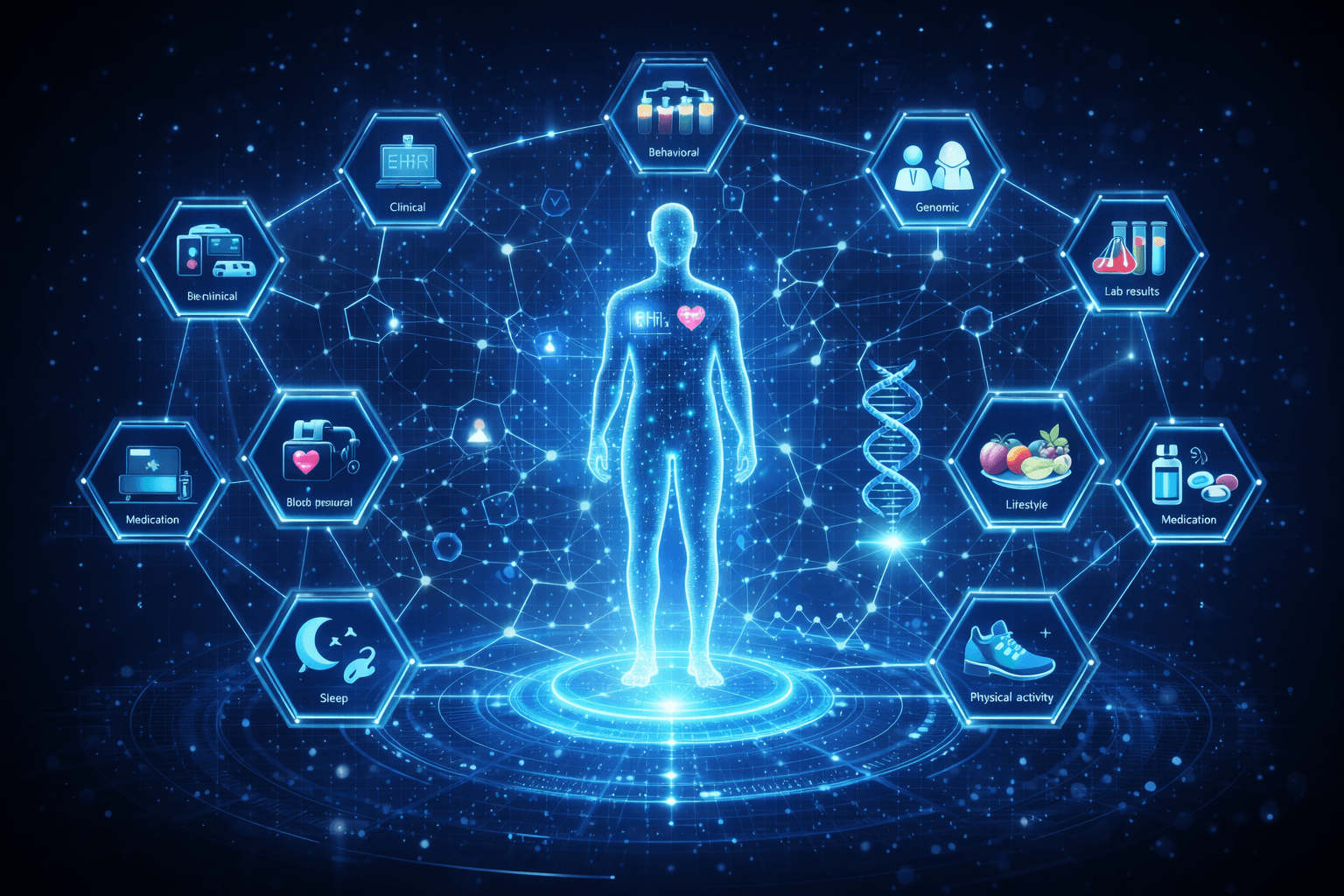
A living patient model integrating clinical records, genomics, lifestyle, and real-time wearable data. AI reasons about the whole person, not averages.
• Continuously updated patient context
Medical Knowledge Graphs
Validated maps of diseases, symptoms, treatments, and interactions. Every recommendation traces back to an authoritative source.
• Explainable, auditable reasoning
AI Agentic Frameworks
Autonomous agents that gather data, apply clinical rules, and coordinate across systems to complete full care workflows.
• Documentation to decision support
Multi-Level Validation
Consistency checks, knowledge validation, safety flags, and patient-context verification before any insight reaches a clinician.
• AI augments, never replaces judgment
4 Pillars of HIKIGAI Platform

Extensibility
SMART on FHIR, EHR integrations, pre-built connectors
Deep Personalization
360-degree patient view via knowledge graphs

Developer Experience
Clean APIs and pre-built agents, ship in days

Privacy Centric
Patient-controlled data, full compliance
Platform Components
Data Infrastructure
The Data Flywheel
One API, one patient view. Normalizes data from EHRs, wearables, labs, imaging, and genomics.
Agent Marketplace
AI Agents App Store
Pre-built, validated agents: patient summaries, drug interaction checks, prior auth, and more.
Coming Soon: Open Development Platform
We're opening our platform to health tech startups, hospitals, and developers. Build production-grade healthcare AI on proven infrastructure.
Healthcare AI Done Right
The promise of AI in healthcare has always been about improving outcomes: helping clinicians make better decisions, reducing administrative burden, and ultimately delivering better care to patients. Realizing that promise requires AI that is accurate, accountable, and aligned with how medicine actually works.
The Hikigai Platform is our answer to the question of how healthcare AI should be built. Not as a statistical guessing machine, but as a rigorous system grounded in medical knowledge, personalized to individual patients, and validated at every step. Healthcare is not about probabilities. It is about people. And that is exactly who we are building for.